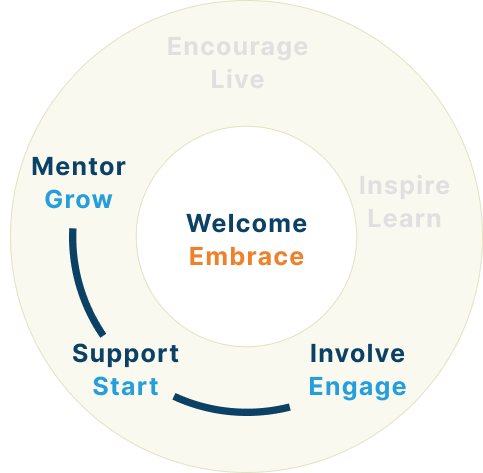
Fill the Gap cycle: welcome, involve, support, mentor, inspire, encourage

Fill the Gap

Fill the Gap is a one-year rotational program for young graduates in Bergamo. Through four internships of three months each, participants experience different roles in companies and social organisations, discovering what gives them purpose while building the human skills that carry a career forward.

The challenge

Despite a strong affinity to the city of Bergamo, Italy and its heritage, many young residents face fragmented access to housing, work, community, and civic participation, making it difficult to build stable, long-term futures in the city.

For young people moving from education into work, the outlook isn't exactly optimistic. Technology is automating jobs, wages are low, youth unemployment is high across much of Europe, and a growing number of young adults struggle to become independent from their families because of the rising cost of living.

Set in the city of Bergamo, Italy, our brief was:

How might we support young adults to feel confident and secure about their future?
Context

A city with jobs, but not the right match

Bergamo tells a different story than other cities in Europe. It has Italy's lowest unemployment rate, under 2%. Yet up to 40% of local enterprises struggle to find staff with the right technical and soft skills (Chamber of Commerce). Young graduates enter the workforce underprepared in practical and interpersonal skills, and unsure of which direction to take.

The challenge wasn't a lack of jobs. It was a gap between young people and the work that could shape them. The framing of the research and possible opportunities was to focus on the:

Transition into the workforce and the compatibility between young adults & job opportunities.

Fill the Gap

Role: Service Designer: research, synthesis, co-design and concept development
Team: Diana Chaves (architect) · Haley Rowland (computer scientist) · Daniela Gómez (policy-maker)
Duration: 3 weeks
Context: Service Design course, Interaction Design Programme, CIID, 2026
Methods: Street interceptions · In-depth interviews · Ecosystem mapping · Co-design · Storyboarding · Concept testing

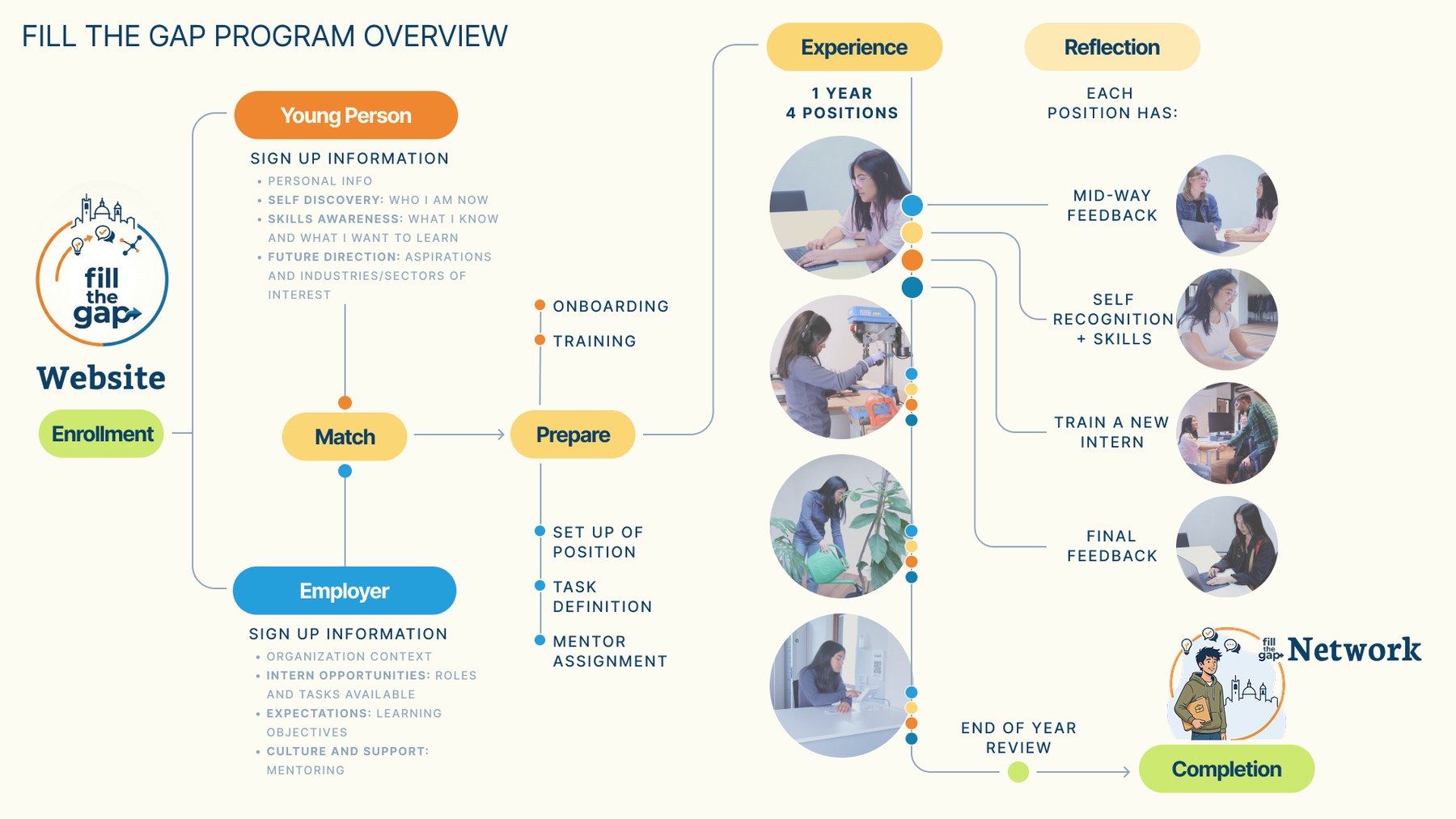
Fill the Gap is a one-year rotational program for young graduates in Bergamo. Young people entering the workforce carry questions that keep them stuck: What should I do? What if I choose wrong? Fill the Gap turns those questions into an invitation to act. Instead of trying to figure out the "right" first job in their heads, participants answer those questions through practice.

Throughout the year, participants receive actionable feedback focused on soft skills, take time for self-reflection, and help train the next group of participants. Organisations, in turn, get motivated young talent and a structured way to develop the skills they struggle to find.

Fill the Gap program overview: enrollment, match, prepare, one year of four positions with feedback, and completion
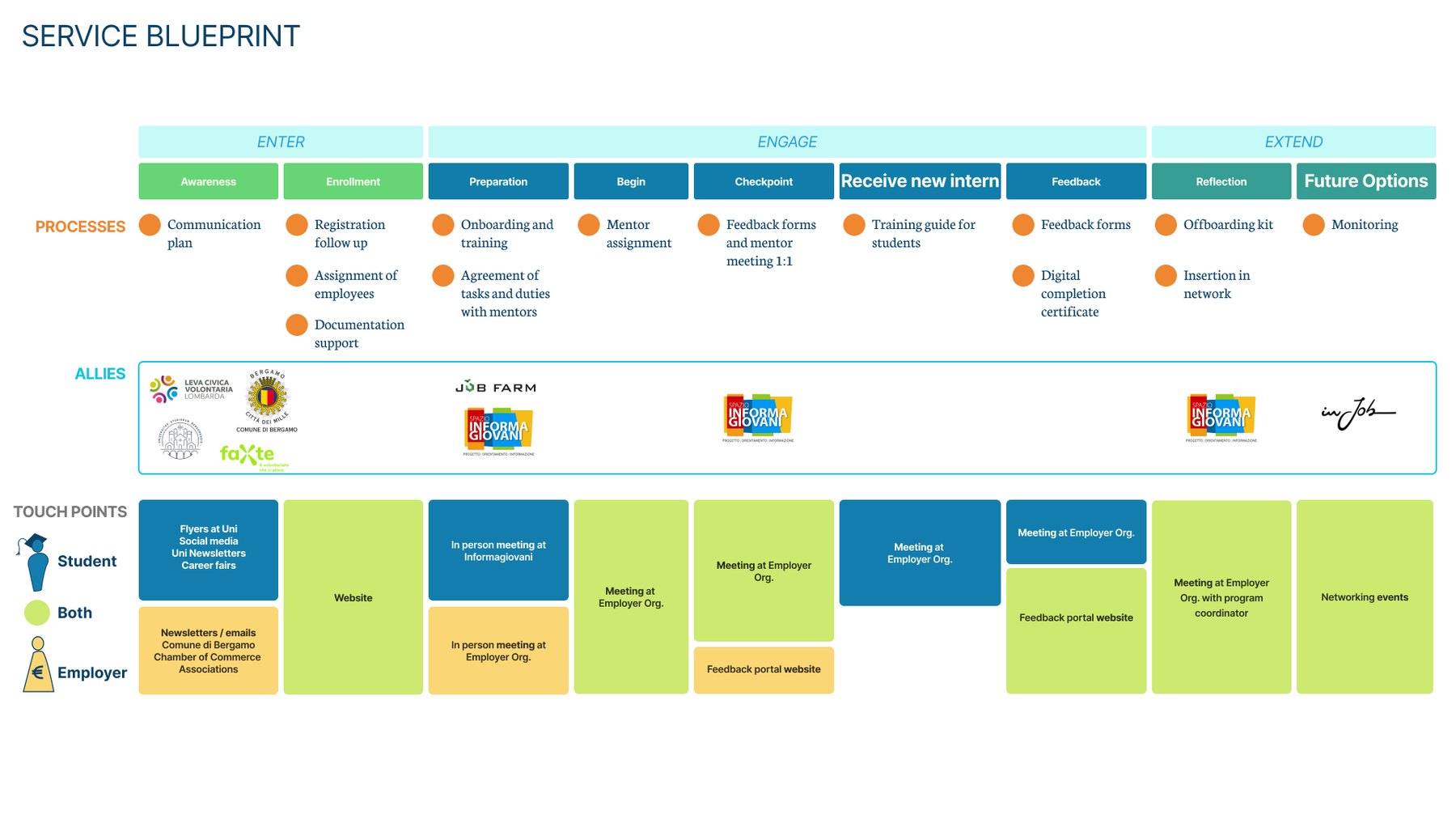
Service blueprint: enter, engage and extend phases with processes, allies and touchpoints for students and employers

End-of-Year Review

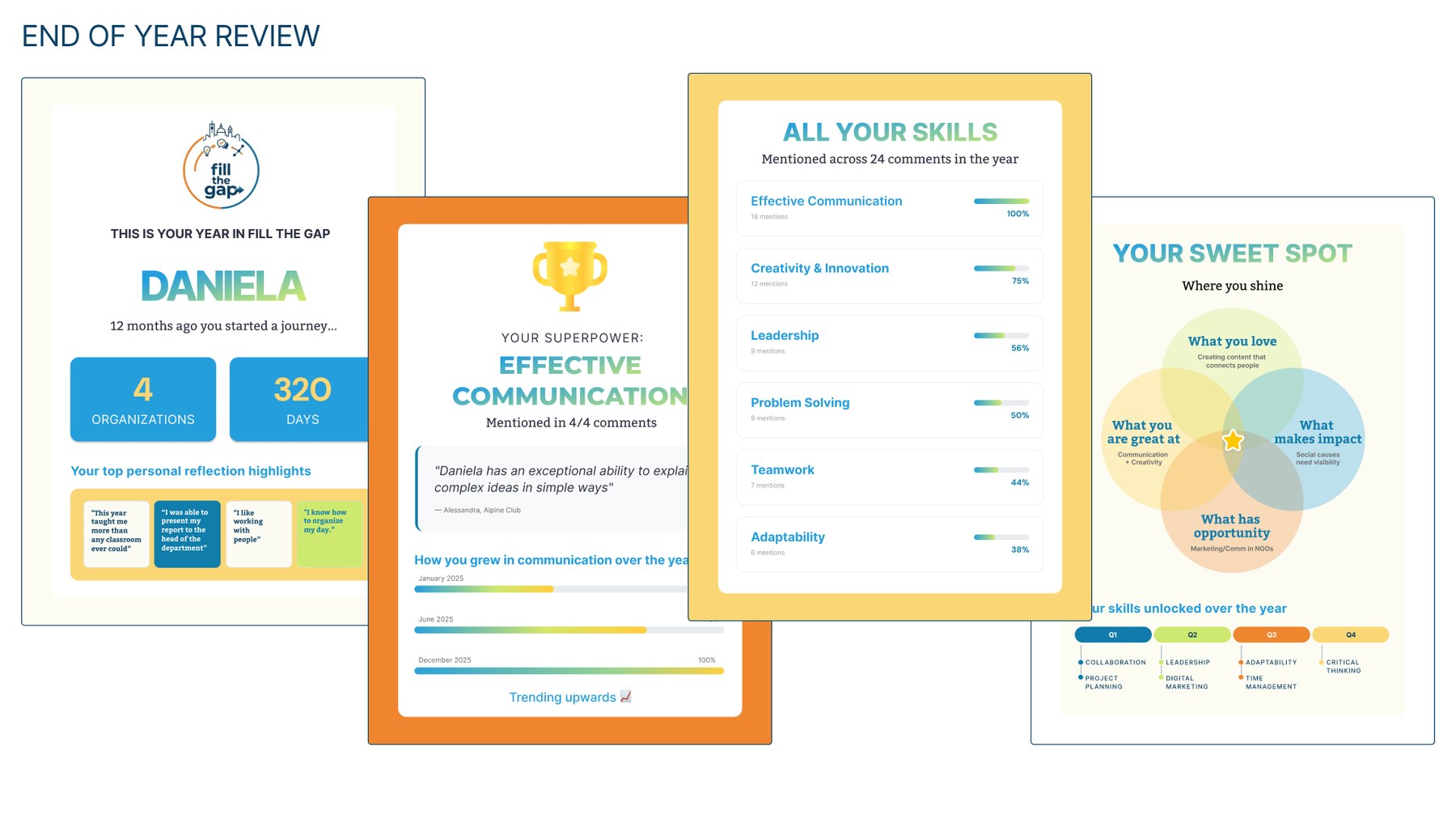
After each internship, participants capture what they gained: the skills they developed, what they learned, and a short reflection on what the experience taught them about themselves. At the end of the year, these reflections come together in an AI-supported review that mirrors back their growth and highlights opportunities and next steps worth exploring.

This builds on a service that already exists in Bergamo's ecosystem called "Informa Giovani". Young people can join an orientation programme that helps them rethink how they approach the labour market, by identifying their strengths and looking for roles where they can add value. But our research showed that many leave that process with more questions than answers. That's a good sign: they're reflecting. What was missing was a way to channel those doubts and turn them into next steps.

Fill the Gap fills that gap, turning questions into experience, and experience into direction.

End-of-year review: a personal summary of the year, the participant's superpower, all their skills, and their sweet spot between what they love, what they're good at, what makes impact and what has opportunity

My role

In a team of three (an architect, a computer scientist and myself), I took part in every stage, from research to concept. I focused especially on:

  • Leading interviews with employers and expert organisations
  • Building the ecosystem map of actors in Bergamo
  • Designing the future journey map

My background in talent policy, after leading a national talent framework at Costa Rica's Ministry of Foreign Trade, helped the team connect young people's needs with employers' realities.

The process

01 · Discover

We spoke with 24 people in Bergamo:

12 street interceptions with young people, to capture first reactions and everyday perspectives

12 in-depth interviews with university students, young professionals, student representatives, employers and expert organisations

02 · Define

Key insights

1. Bergamo youth struggle to enter the job market because they lack the self-knowledge to identify which opportunities are right for them.

2. The jobs that feel random at the time are often the ones that matter most in hindsight.

3. Companies know they need young talent, but struggle to create loyalty among a young culture that prioritizes new experiences.

This led us to reframe the challenge:

How might we help young people see temporary work not as something to get through, but as an intentional way to discover what they're good at and what they want?

"I want to find something that makes me feel excited to wake up in the mornings, but it's not easy"
— Young adult and student from Bergamo

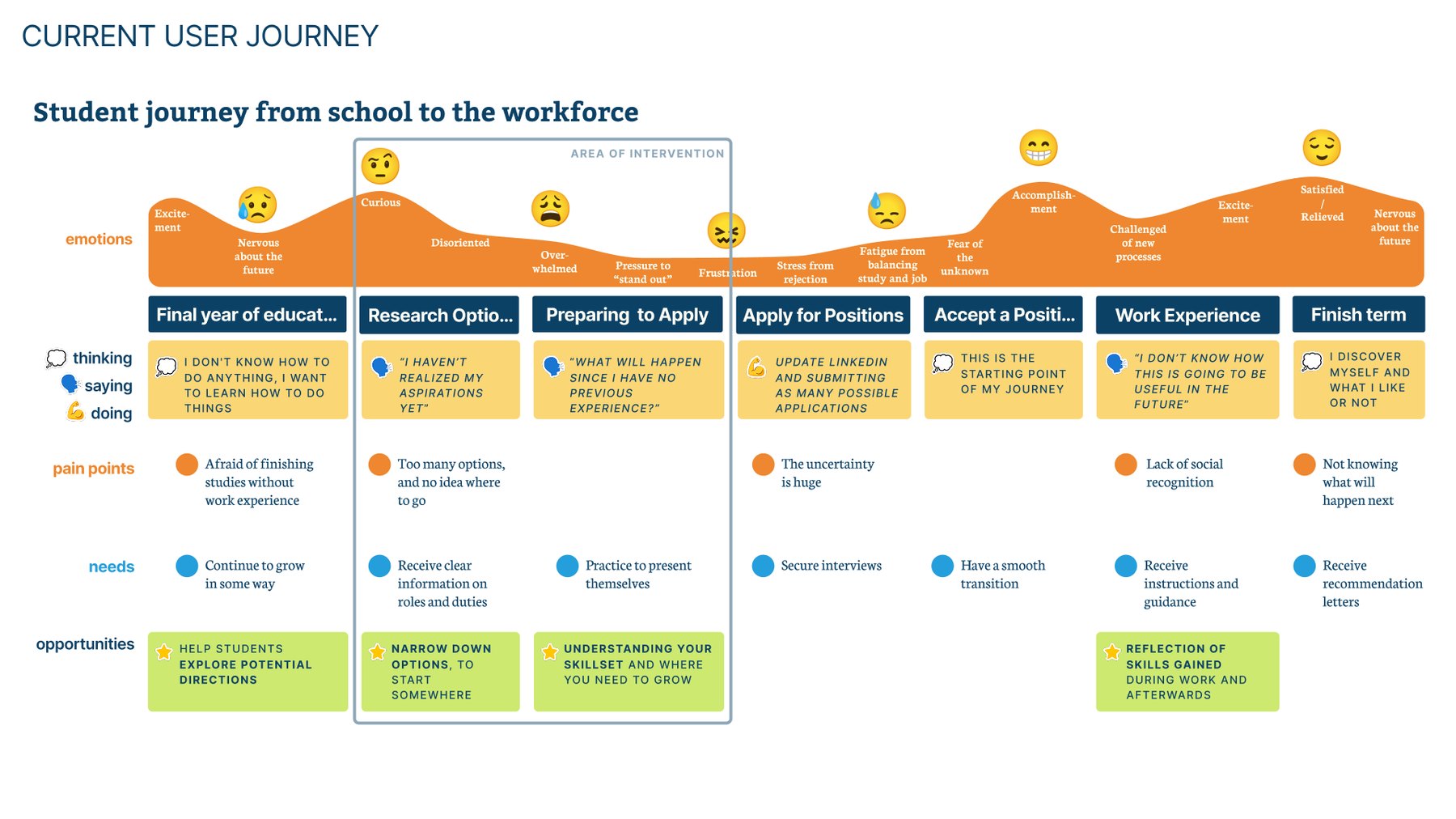
Current user journey: student journey from school to the workforce, with emotions, pain points, needs and opportunities at each stage

03 · Ideate & Test

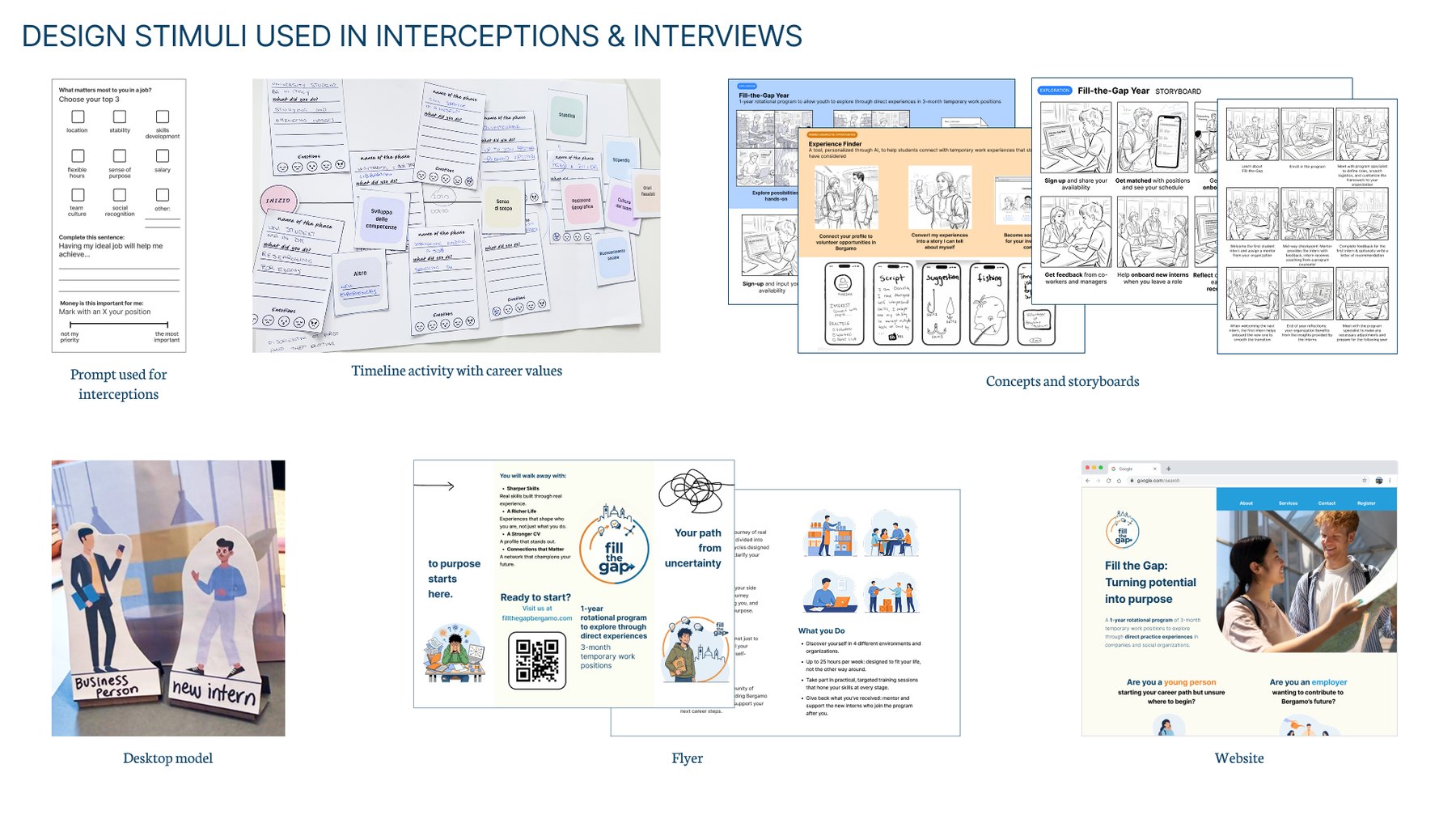
We ran co-design sessions with students and employers, then designed interventions to spark conversations between them and tested them with users. Storyboards and concept flyers helped us test how young people and companies responded to the idea before defining the full service.

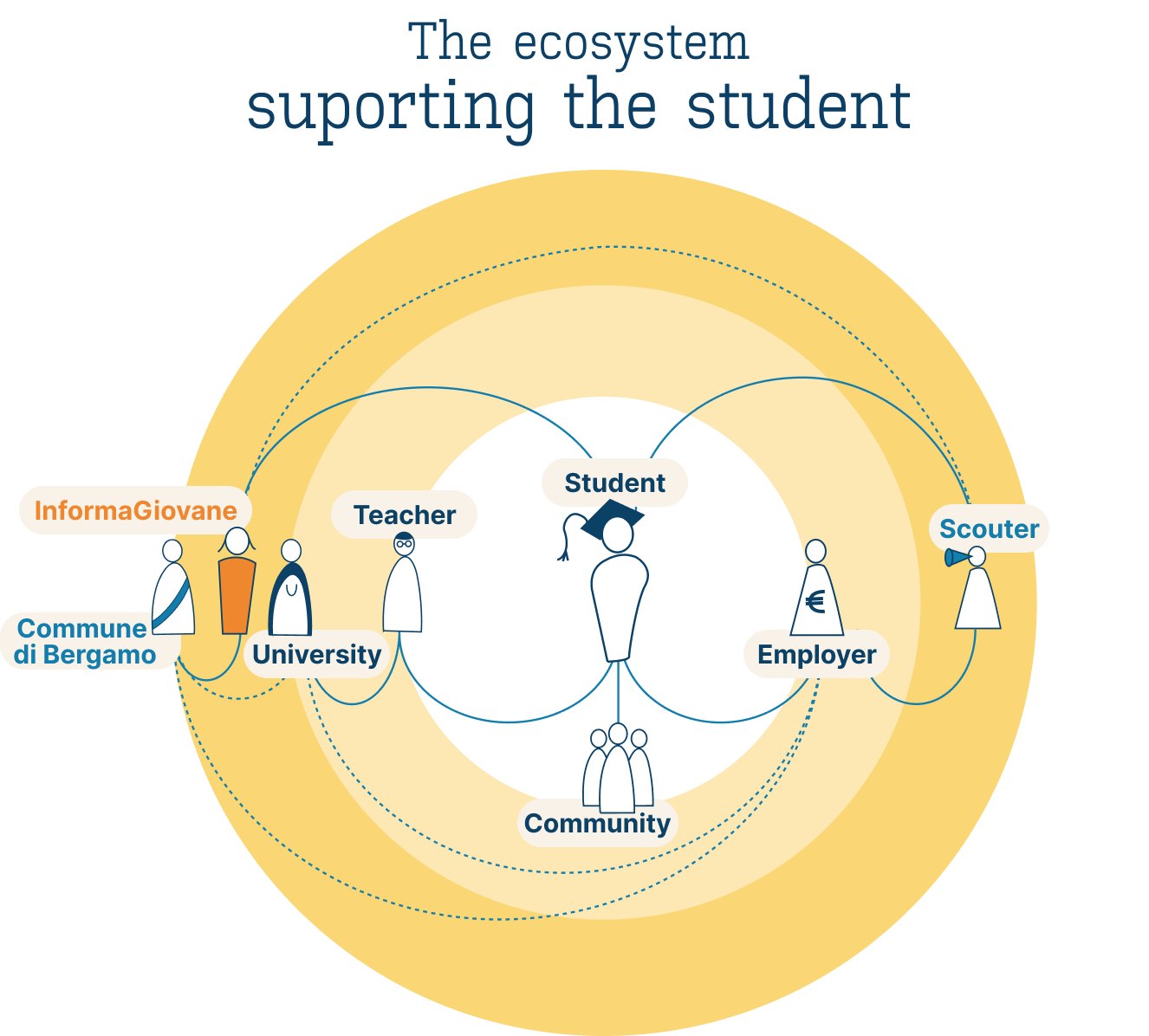
We then mapped the ecosystem of actors shaping the transition from education to work.

The ecosystem supporting the student: university, teachers, employers, scouters, community, InformaGiovani and the Comune di Bergamo

Research

In our research plan, some of our questions focused on the real pain points and expectations of young people in Bergamo, Italy. We wanted to understand the perspective of both those going through the transition from education to work and those who had already made it.

We also asked about the services available in the city: who provides them, whether they are enough, and whether they work in a coordinated way. Starting with open-ended questions helped us identify opportunity areas and build a map of the key stakeholders involved in choosing a job, and of how closely that choice is linked to personal aspirations.

Understanding our users

Young people aged 18–25 in Bergamo, studying, recently graduated or in their first jobs.

What they want from work:

  • Purpose: a job that feels aligned with what matters to them
  • Flexibility: hours that let them keep studying
  • Growth: a chance to develop their skills
  • New experiences: work that opens up new ways of living and learning

What holds them back:

  • Pressure to choose "right": anxiety about making the right choice and having a clear path from the start
  • Undervalued experience: temporary jobs aren't socially recognized, so what young people learn there often goes unseen

By using different research stimuli in the research process, we were able to collect qualitative data that along the process informed the decisions and the concept.

Design stimuli used in interceptions and interviews: prompt cards, timeline activity, storyboards, desktop model, flyer and website
Fill the Gap: turning purpose into potential